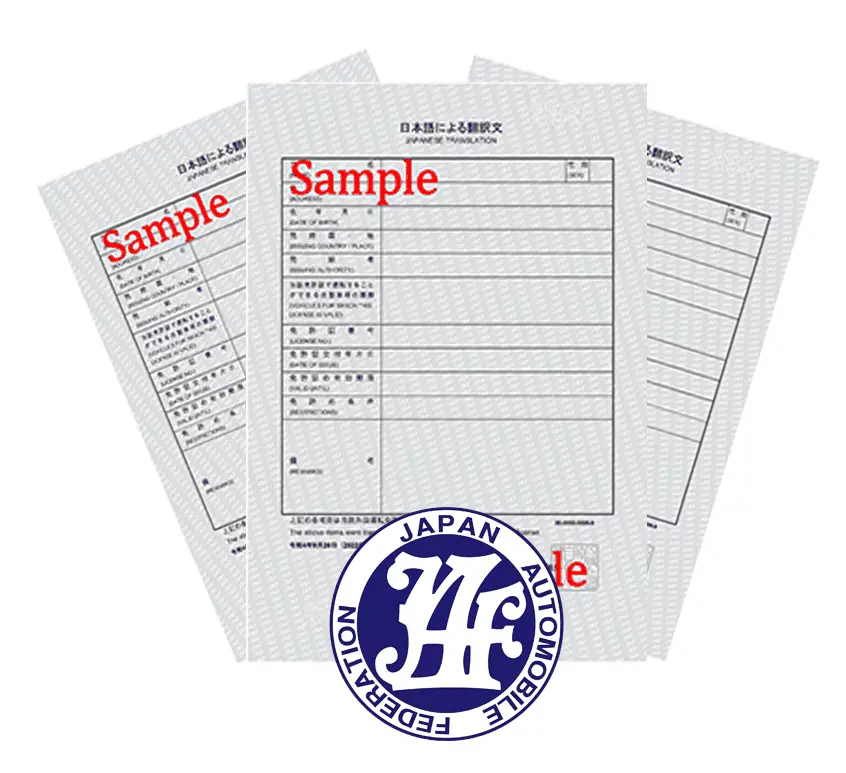
Official JAF translation of your licence to drive in Japan: price (6,000 yen, about 33 euros), lead times, access from Japan, and the DrivinJapan solution for getting it sorted before you leave. Complete guide + mistakes to avoid
Heading to Japan and want to rent a car? In many cases, you need an official JAF translation in addition to your licence. Here is a complete, clear and up-to-date guide: how much it costs, how long it takes, and how to choose the best option for your trip.
What you need to know (in 30 seconds)
✅ JAF is the official body in Japan for licence translations.
✅ You can apply yourself in Japan (≈ 6,000 yen, or about €33).
✅ Or get it sorted before you leave to avoid stress, refusals and lost time at the critical moment.
Transparency: all online services (including DrivinJapan) rely on JAF, because it is the only official body recognised in Japan by rental companies and the Japanese authorities. The difference lies mainly in planning ahead, checking, support and peace of mind.
Why an official JAF translation is necessary
When you are planning a trip to Japan, a car is often the best way to discover the country "off the beaten track": scenic roads, villages, secluded onsen, lakes and mountains… But car rental in Japan comes with one simple rule: you must be able to prove that you are entitled to drive under local rules.
And this is where many travellers get it wrong: the International Driving Permit is not a universal solution. Depending on your country, your International Driving Permit may not be accepted in the way you imagine, and Japan sometimes requires a specific format: the official translation certified by JAF.
In practice, this translation acts as an "administrative bridge": it allows rental companies, the police and insurers to read and check your licence in a format recognised in Japan. Without it, you risk:
- being refused a car at the rental desk, even if you have booked and paid,
- complications if you are stopped at a roadside check,
- problems in the event of an accident (if your documents are not compliant).
The good news: the solution is simple, official and widely used. You just need to choose the option that best suits your travel style: apply on the spot (often the cheapest) or get it sorted before you leave (often the most stress-free).
Who needs one? (depending on your country and your licence)
Japan has a particular system: certain foreign licences can be used in Japan provided you have an official translation. This applies in particular to European countries whose travellers frequently visit Japan.
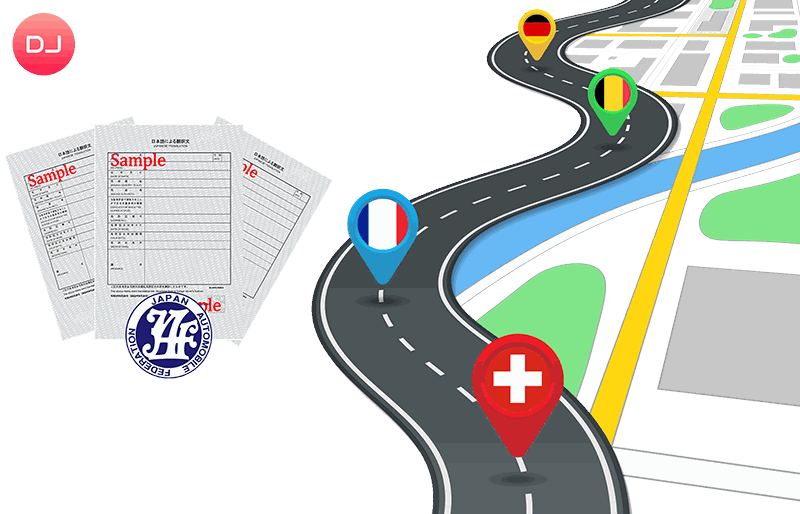
In practice, if you are Swiss, French, Belgian or German (and others depending on the agreements), the recognised way to drive is: original licence + official JAF translation.
💡 Golden rule: the translation never replaces your licence. You must always present both (licence + translation), and often your passport when renting.
Tip: if your trip starts with a road trip straight from the airport (Hokkaido, Kyushu, Okinawa, etc.), plan ahead. If you are staying a few days in Tokyo/Osaka before renting, you can consider applying on the spot.
Option 1 — Get the translation directly from JAF (in Japan)
This is the most economical method, and it suits many travellers perfectly. JAF (Japan Automobile Federation) is the recognised body in Japan for producing this official translation.
Official JAF website (accessible only from Japan)
Price: about 6,000 yen (≈ €33)
The cost is generally around 6,000 yen (the exact amount may vary slightly). Compared with assisted services, it is unbeatable if your priority is budget.
Lead times: sometimes quick… but not always predictable
Depending on the time of year, the workload and the location, the processing time can range from a few hours to 1–2 working days (sometimes longer during busy periods). If your road trip starts immediately, the "lead time" factor becomes critical.
An important limitation: accessibility and timing
Many travellers discover a practical constraint: the application or certain useful pages may only be accessible from Japan. As a result, you cannot always prepare everything in advance. It is not a deal-breaker, but it means you are "gambling" the start of your road trip on what happens on the spot.
Pros / cons (honestly)
- ✅ Pro: the price (low-budget friendly).
- ✅ Pro: simple when everything is in order.
- ⚠️ Con: you have to handle the application in Japan (time + organisation).
- ⚠️ Con: if there is a problem with your licence (illegible, conditions, etc.), you find out too late.
🎯 Who is it ideal for? Travellers who stay at least 2–3 days in a city before renting, or those who are happy to accept a few surprises in order to save money.
Option 2 — Get it sorted before you leave with DrivinJapan (time saved & peace of mind)
The second approach: you apply before you leave via DrivinJapan to avoid surprises on the spot. The point here is not to "do better than JAF": JAF remains the official reference. The point is to reduce risk and stress in advance.
Why it's reassuring (and when it's really worth it)
If you arrive in Japan with a tight itinerary (road trip starting the next day, car already booked, remote hotel, family/baby…), losing a day can be costly: cancellations, changed bookings, unplanned alternative transport, etc. Planning ahead allows you to:
- make sure your application is compliant (checked in advance),
- avoid a "surprise" refusal at the worst possible moment,
- drive as soon as you arrive (depending on your plans),
- free yourself from the mental load of paperwork.
Transparency: all online translation agencies and travel agencies go through JAF
A key point that is too rarely stated clearly: all online services rely on JAF to obtain the official translation, because it is the officially recognised body. The difference lies in the support: preparation, checking, assistance and planning before you leave.
Common mistakes (and how to avoid them)
The most common hold-ups are not "complicated", but they happen at the worst possible moment: the day before departure, or on the day of the rental. Here are the mistakes that waste time, and how to avoid them easily.
1) Thinking "I'll sort it out when I get there" with a tight itinerary
If you land and head straight to a region where everything is done by car (Hokkaido, rural Kyushu, the Japanese Alps, etc.), dealing with paperwork on arrival can turn into a race against the clock. In this case, plan ahead: you will pay a little more, but you will often save a day (or a cancellation).
2) Having a damaged or illegible licence
A licence that is folded, faded or partly illegible can complicate the translation. Most travellers don't realise this, because it causes no problems in everyday life. Before you leave, take the time to check that it is legible (front/back) and that the information is consistent.
3) Confusing a "translation" with an "International Driving Permit"
Many people think that "International Driving Permit = universal". In Japan, it is not that simple. Depending on your country and type of licence, the JAF translation may be the option that rental companies expect and recognise.
4) Forgetting documents at the rental desk
On the day, the rental company will usually ask you for: passport + original licence + official translation. Forget one and you may be refused, even if the booking has been paid for.
Practical tips depending on your itinerary (the "real world" guide)
Scenario 1: You are staying in Tokyo/Osaka for 3 days before renting
In this case, applying on the spot can be a solid option if you don't mind a little organisation. You have some leeway and can manage the timing without extreme stress.
Scenario 2: Road trip straight from arrival (airport → rental → off you go)
Here, planning ahead is generally the best strategy. The "risk" is not dramatic… but the cost of something unexpected can be high: changing a booking, losing a night, or having to use alternative transport.
Scenario 3: Family trip (children, baby, tight schedule)
With a family, the mental load is already huge: schedules, tiredness, luggage, jet lag. Every extra formality adds to the stress. Planning ahead lets you save your energy for the trip, not the paperwork.
Scenario 4: Low-budget trip (flexible, no immediate rental)
If your priority is budget and you are flexible, applying to JAF on the spot is often the best option. You save money and stay in control by handling everything yourself.
✅ In a nutshell:
Budget & flexibility → JAF on the spot.
Tight timing & peace of mind → get it sorted before you leave.
FAQ — JAF translation & driving in Japan
Can I drive with just the translation?
No. You must present the translation + your original licence (and often your passport).
How long is the translation valid?
In practice, the translation is tied to your licence. If your licence changes or expires, you will need a new translation.
Do all online agencies go through JAF to obtain translations?
Yes, all online agencies and travel agencies use JAF's services to obtain driving licence translations for Japan. Online services mainly stand out through their support, planning ahead and the responsiveness of their customer service.
Which option should I choose if I want to be 100% sure?
If your priority is certainty and timing (immediate rental), get it sorted before you leave. If your priority is budget and you have time, apply on the spot.