The reference guide to driving in Japan with a European licence: International Driving Permit, official JAF translation, 2026-2027 prices and lead times, validity, the rental counter, road rules, a country-by-country table, a countdown plan, a checklist and FAQ.
Driving licence translation for driving in Japan: the ultimate 2027 guide
Everything you need to know before getting behind the wheel in Japan, in five essential points: why the International Driving Permit isn’t enough, what the official JAF translation is and what it costs, when and how to get it, how long it is valid, and what awaits you at the rental counter and then on the road. This guide sums up the experience of 15,000 customers served since 2017 and, for each point, links to our detailed articles.

The essentials in 30 seconds. With a French, Belgian, Swiss or German licence, the International Driving Permit is worthless in Japan. You need an official Japanese translation, issued by the JAF, valid for one year from your entry into the country. The JAF only issues it online and only from within Japan, for 6,000 yen. From Europe, DrivinJapan submits the application for you and hands you the same official translation before you leave, for €59.90 per licence. The rest of this guide explains why, how, and what to avoid.
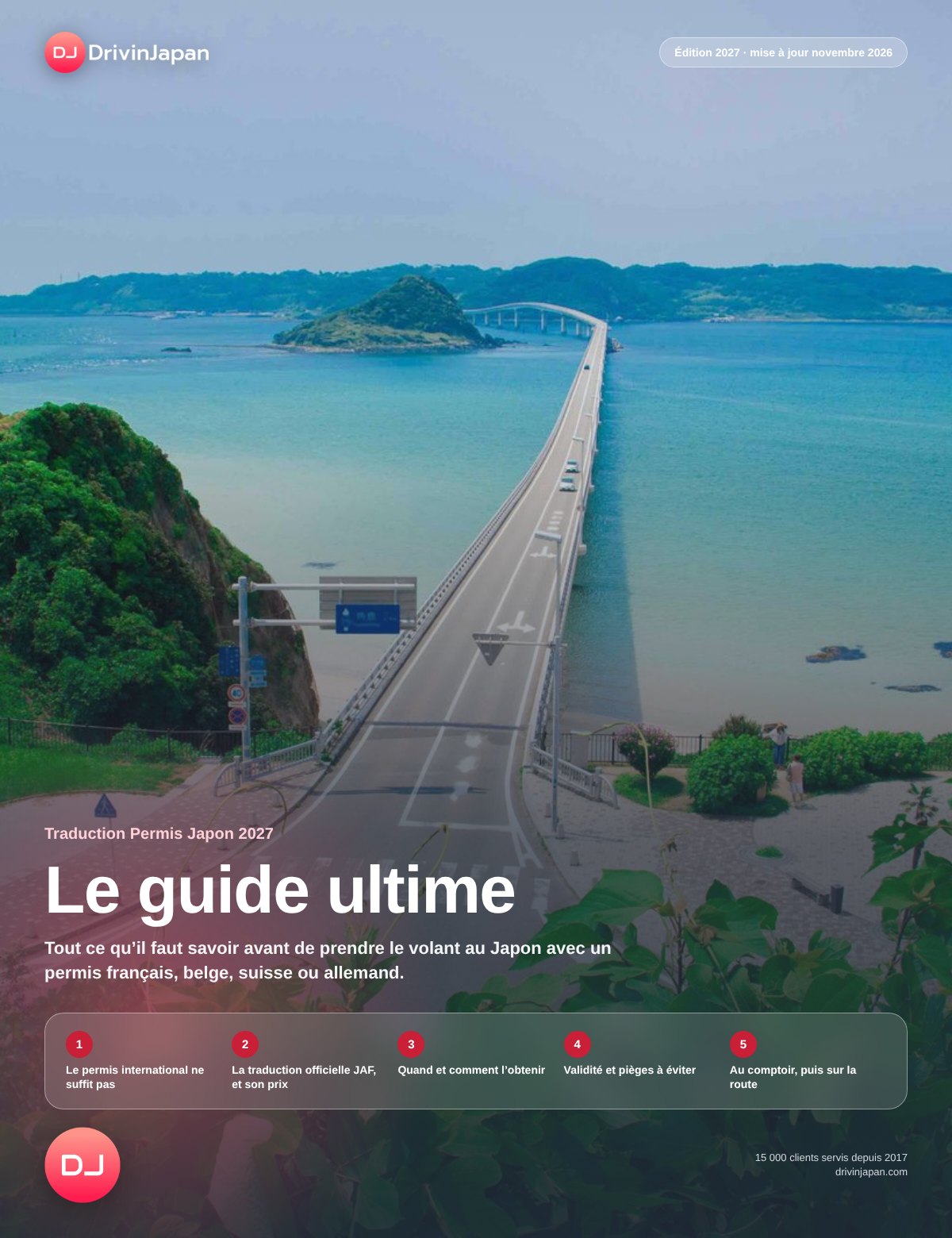
Download the guide as a PDF
The 12 pages of this guide in an illustrated version, to keep on your phone or print out: documents by country, procedure, validity, countdown plan, checklist and the ten mistakes to avoid.
Download the guide (PDF) Free, no sign-up required. 2027 edition, updated November 2026.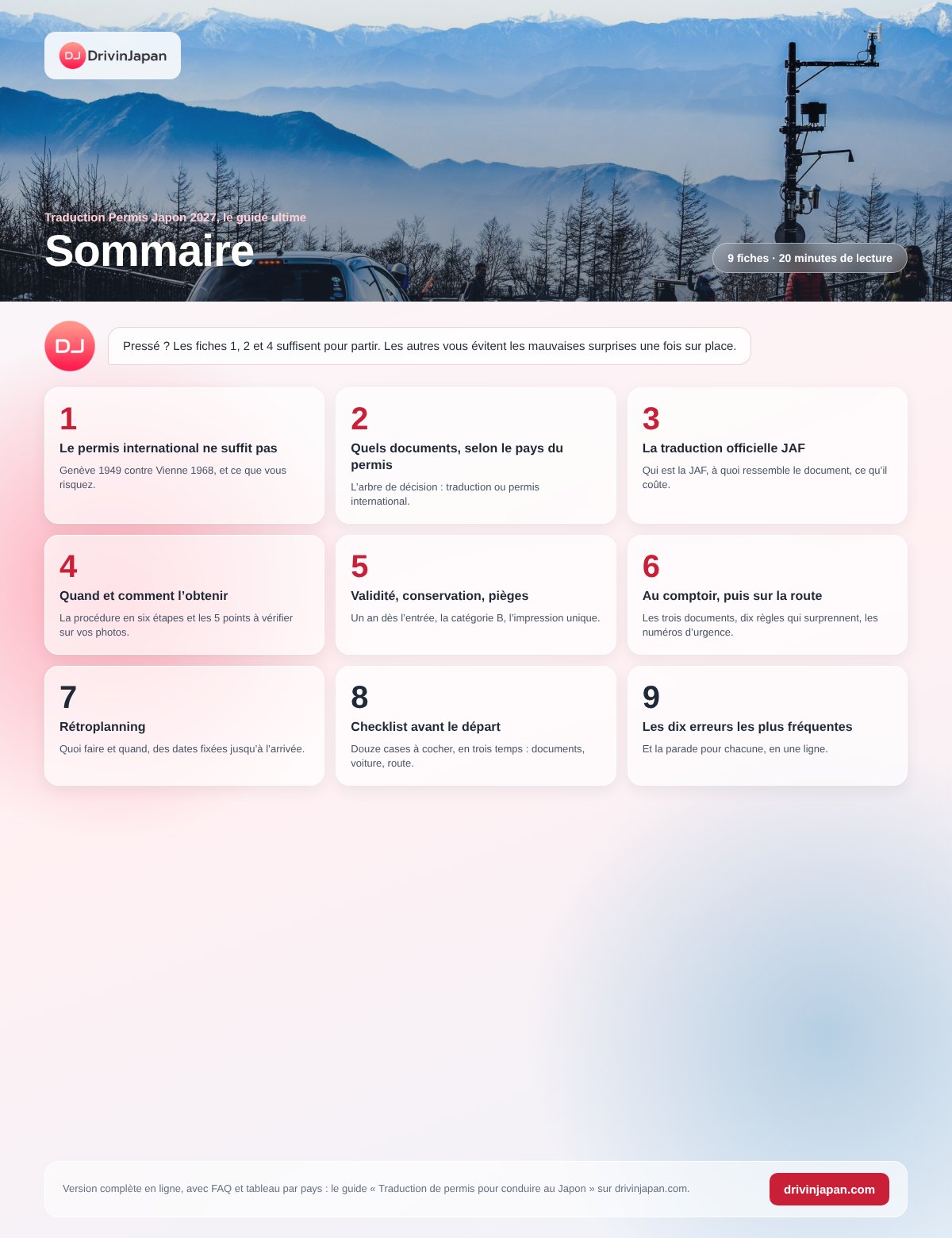
Who this guide is for
This guide is written for drivers holding a licence issued in France, Belgium, Switzerland, Germany or Monaco who plan to rent a car in Japan for a holiday, family or business stay of less than a year. If your licence comes from another country, the country-by-country table will tell you in ten seconds whether you need the translation or whether the International Driving Permit is enough.
It is also for travellers who drove in Japan a few years ago and think they know the procedure. Since 2022, almost everything has changed: no more JAF counter, no more postal applications, a fee that doubled in 2026, and online applications that are impossible from abroad. Advice read on a forum in 2019 is now wrong, and that is precisely what gets travellers into trouble at the airport.
We are DrivinJapan, an Osaka-based company that has helped more than 15,000 customers obtain their official translation since 2017. What you will read here comes from those files, from our direct exchanges with the JAF and from the questions our customers ask us every day. When the official rule and actual practice differ, we say so.
1. The International Driving Permit is not enough
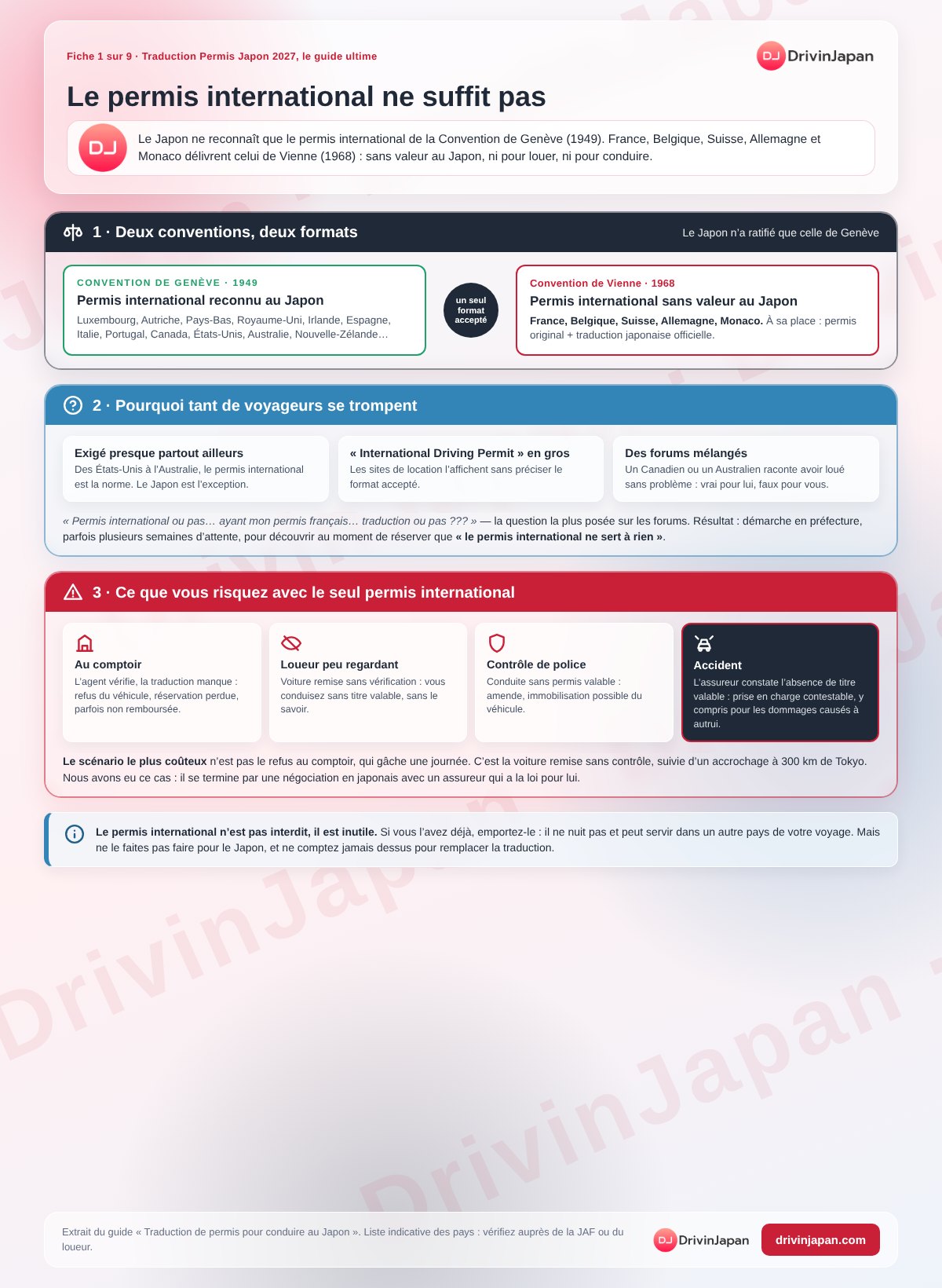
The short answer: Japan only recognises International Driving Permits issued under the 1949 Geneva Convention. France, Belgium, Switzerland, Germany and Monaco issue theirs under the 1968 Vienna Convention. That format has no value in Japan, either for renting a car or for driving. Instead, Japan requires the original national licence accompanied by an official Japanese translation.
Why so many travellers get it wrong
It is the most frequently asked question on every travel forum, and almost always in the same tone: “International permit or not… having my French licence… translation or not???”. The confusion is understandable. The International Driving Permit is required almost everywhere else in the world. Rental websites display “International Driving Permit” in big letters. And on international forums, a Canadian or an Australian explains that they rented without any problem with their International Driving Permit, which is true for them and false for you.
The result: every year, travellers go through the process with the authorities in their home country, sometimes wait several weeks, and find out when booking the car that “the international permit is useless”, to quote a phrase we have read hundreds of times. The worst part isn’t the wasted effort; it is what happens next if nobody has warned them.
Two conventions, two formats
The 1949 Geneva Convention and the 1968 Vienna Convention are two international treaties on road traffic. A country applies one or the other and issues its International Driving Permit in the corresponding format. Japan has only ratified the Geneva Convention. The French- and German-speaking European countries, with the notable exceptions of Luxembourg and Austria, have switched to the Vienna Convention. The details of this rule, country by country, are in our article Is the International Driving Permit enough to rent a car in Japan?
What you risk with only an International Driving Permit
| Situation | What happens | Consequence |
|---|---|---|
| At the rental counter | The agent checks the documents; the translation is missing | Vehicle not handed over, booking lost, sometimes not refunded |
| Not-so-careful rental company | The car is handed over without any checks | You are driving without a valid licence without knowing it |
| Police check | Original licence and International Driving Permit, no translation | Driving without a valid licence: fine, possible impounding of the vehicle |
| Accident | The insurer notes the absence of a valid licence | Cover disputed, including for damage caused to third parties |
The most expensive scenario isn’t being turned away at the counter, which ruins a day. It is the car handed over without checks by a rental company in a hurry, followed by a fender bender three hundred kilometres from Tokyo, where the driver discovers they weren’t covered. We have seen this case. It ends in a negotiation in Japanese with an insurer who has the law on its side.
The International Driving Permit isn’t prohibited, it’s useless. If you already have one, take it with you: it does no harm and may be useful in another country on your trip. But don’t get one for Japan, and never count on it to replace the translation.
2. The official JAF translation: what it is and what it costs
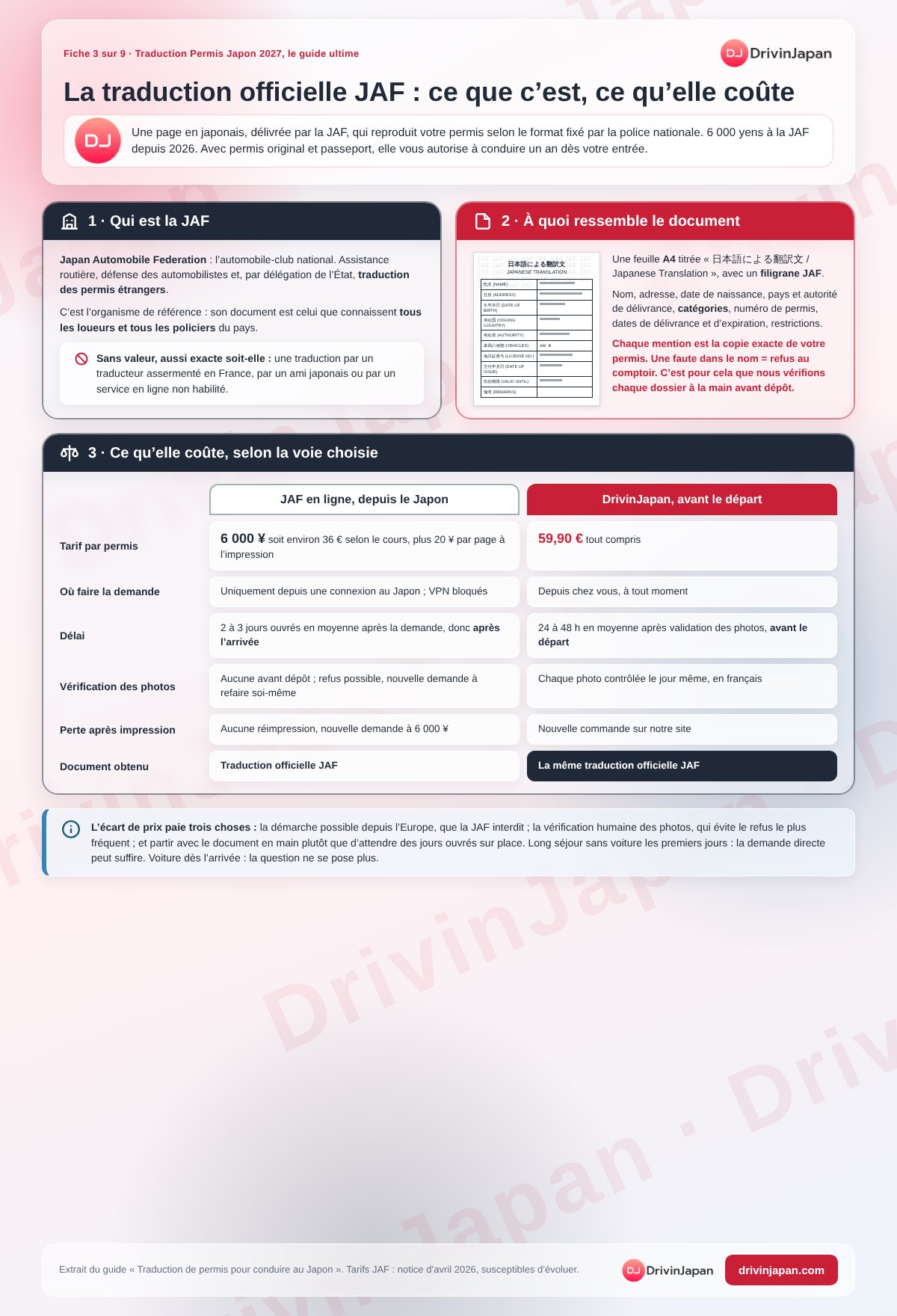
The short answer: the official translation is a one-page document in Japanese that reproduces the details on your licence in a format set by the Japanese National Police Agency. It is issued by the JAF, the Japan Automobile Federation, or by certain diplomatic missions. It has cost 6,000 yen at the JAF since 2026. Presented together with the original licence and your passport, it allows you to drive in Japan for one year from your entry into the country.
Who is the JAF?
The JAF is the Japanese equivalent of a national automobile club: roadside assistance, advocacy for motorists and, on behalf of the State, the translation of foreign licences. It is the reference body: the document it issues is the one every rental company and every police officer in the country knows. A translation by a sworn translator in your home country, by a Japanese friend or by an unauthorised online service has no value, however accurate it may be. We detail its fees, and what the difference with an agency pays for, in How much does the licence translation for Japan cost?.
What the document looks like
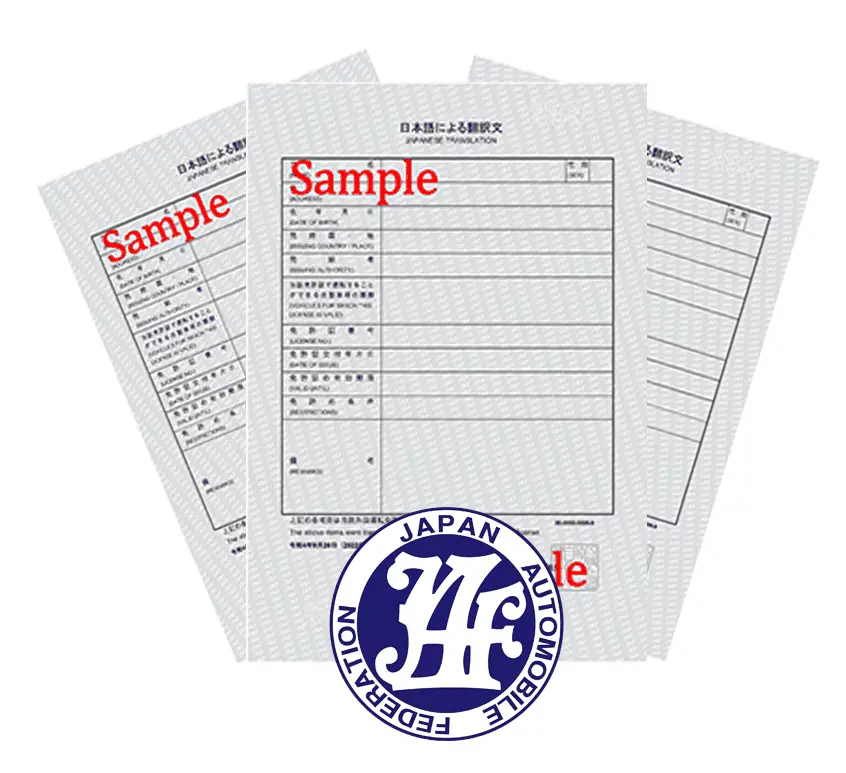
An A4 sheet headed “日本語による翻訳文 / Japanese Translation”, bearing a JAF watermark, with your name, address, date of birth, issuing country and authority, authorised categories, licence number, issue and expiry dates, and any restrictions. Each entry is an exact copy of your licence: the slightest difference between the two documents, a misspelt name for example, leads to a refusal at the counter. That is why we check every file by hand before submitting it.
What it costs, depending on the route you choose
| JAF online, from Japan | DrivinJapan, before you leave | |
|---|---|---|
| Price per licence | 6,000 yen, or about €36 depending on the exchange rate, plus 20 yen per page for printing | €59.90, all-inclusive |
| Where to apply | Only from an internet connection in Japan; VPNs blocked | From home, at any time |
| Lead time | 2 to 3 working days on average after applying, so after arrival | 24 to 48 hours on average after photo approval, before departure |
| Photo check | None before submission; possible refusal, new application to redo yourself | Every photo checked the same day, in English |
| If lost after printing | No reprints, new application at 6,000 yen | New order on our website |
| Document obtained | Official JAF translation | The same official JAF translation |
We prefer to be transparent about the price difference. It pays for three things: the ability to do the paperwork from Europe, which the JAF does not allow; a human check of your photos, which avoids the most common reason for refusal; and leaving with the document in hand rather than waiting several working days on the spot. For a long stay without a car for the first few days, applying directly may be enough. For a trip where the car matters from the moment you arrive, there isn’t really a question.
About the 4,000-yen reprint: the JAF website once mentioned a paid reprint at 4,000 yen. We asked the JAF directly: this option does not exist. A translation lost after printing means a whole new application, paid again at 6,000 yen. We mention this because the incorrect information is still circulating.
What has changed since 2022, and why the forums get it wrong
- Late 2022: the counter was closed. You can no longer walk into a JAF office and leave with your translation an hour later, contrary to what hundreds of forum posts still describe.
- 2025: end of postal applications. Applying by post from within Japan, which allowed a friend there to do it for you, no longer exists.
- Since 2022: online applications only, and only from a Japanese IP address. The testimonials keep coming: “the JAF website detects that we are outside Japan”, “even with a VPN located in Japan, nothing worked”.
- 2026: the fee rises from 4,000 to 6,000 yen per translation.
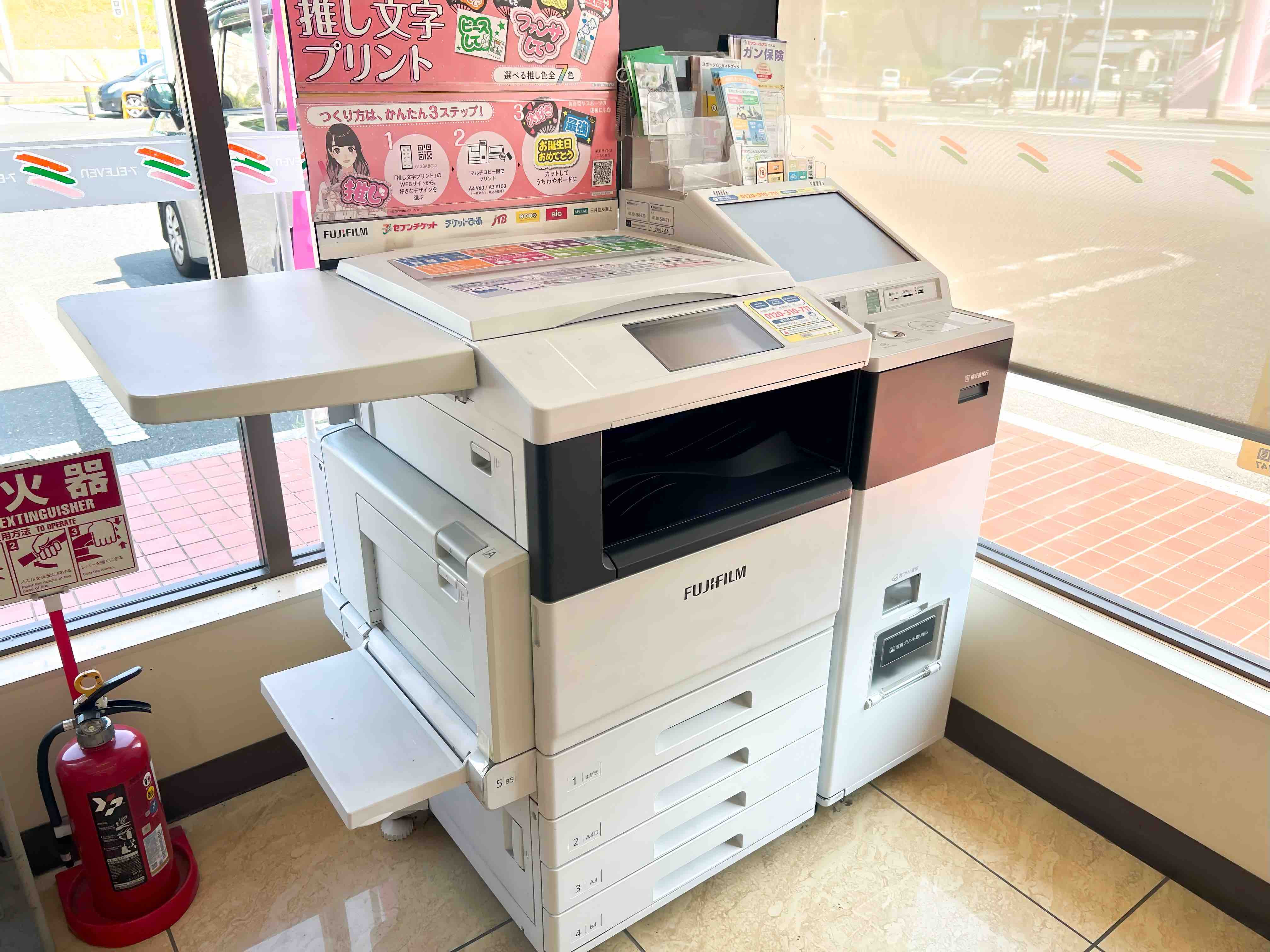
- Printing: the translation is printed at a konbini (7-Eleven, FamilyMart, Lawson or Ministop) using a code. Only one print per application. The PDF alone has no value.
3. When and how to get it without losing a day of your trip
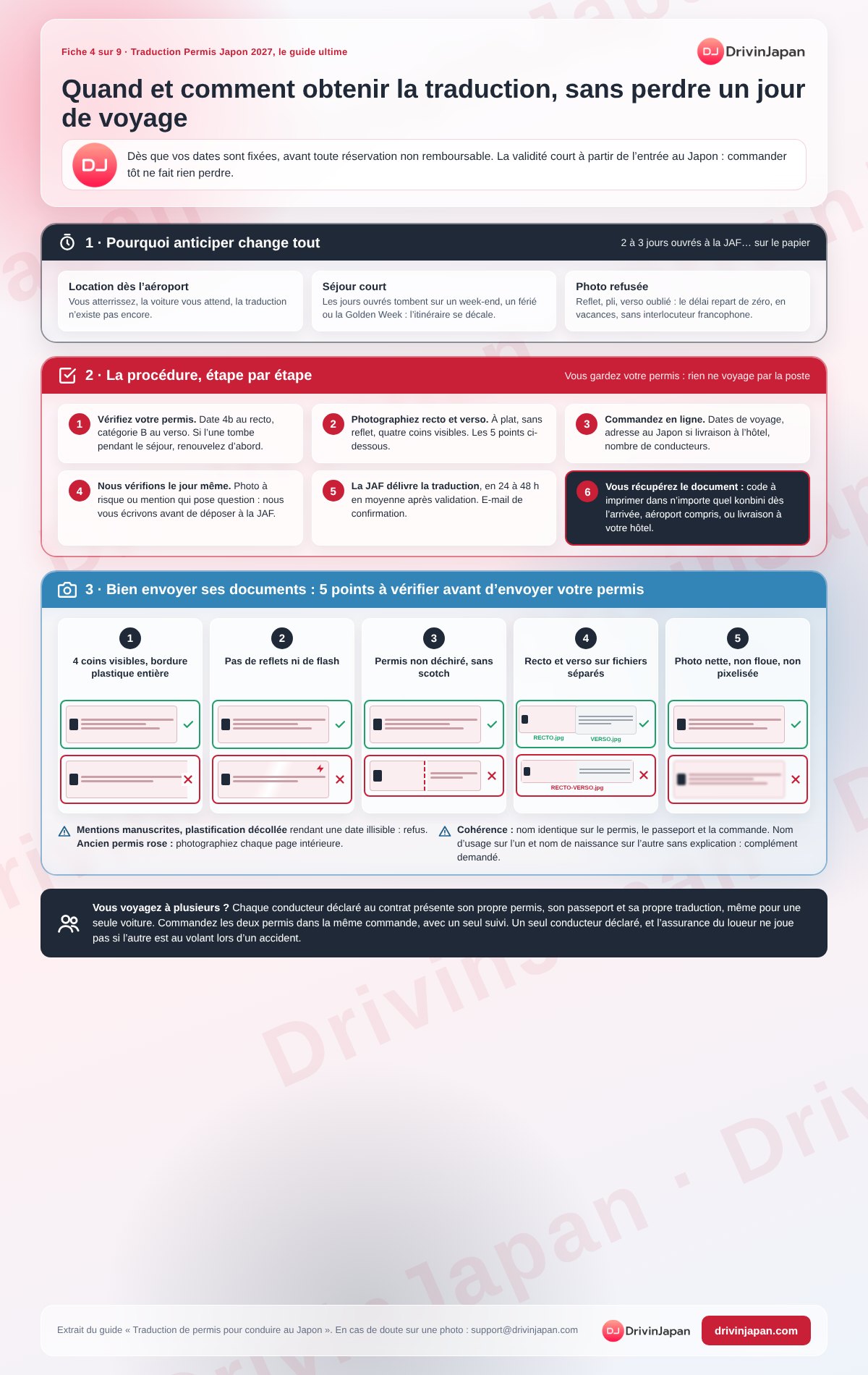
The short answer: as soon as your dates are set, and before you book the non-refundable parts of your trip. Validity is counted from your entry into Japan, not from the issue date: ordering early costs you nothing. From Europe, the only workable route is a Japan-based agency that submits the official application for you.
Why planning ahead changes everything
On paper, 2 to 3 working days at the JAF seems reasonable. In the reality of a trip, three situations come up again and again. Renting from the airport: you land, the car is waiting for you, and the translation doesn’t exist yet. The short stay: the working days fall on a weekend, a Japanese public holiday or Golden Week, and an entire itinerary gets pushed back. The rejected photo: a reflection, a fold, a forgotten back side, and the clock starts again from zero, in the middle of your holiday, with no English-speaking contact. We go into these cases, with real-life examples, in Can you get your licence translated on the spot in Japan?.
One traveller summed up what is at stake on a forum: “if it takes 15 days to get the translation and the trip lasts 15 days, it’s game over”. Lead times are shorter today, but the logic hasn’t changed: the translation is the only document on your trip that you cannot replace along the way.
The procedure, step by step
- Check your licence. The expiry date on the front, and the end-of-validity date for category B on the back. If either falls during your stay, renew your licence first, then order the translation based on the new document.
- Photograph the front and back. Flat, with no reflection, no fingers, all four corners visible, in daylight. On an old paper licence, photograph each inside page. A sharp photo avoids the number one reason for refusal.
- Order online. You enter your travel dates, your address in Japan if you would like delivery to your hotel, and the number of drivers. You keep your licence: no original goes through the post.
- We check your file the same day. If a photo is likely to be rejected, or if an entry on the licence raises a question, we contact you before submitting the application to the JAF.
- The JAF issues the translation, within 24 to 48 hours on average after approval. You receive a confirmation email.
- You collect the document according to the option you chose: a code to print at any konbini as soon as you arrive, including at the airport; delivery to your hotel in Japan; or, as an option, postal delivery to your home in Europe, allowing 10 to 15 working days (prices and current offers on the order form). With the konbini code, we send it to you one to two days before you land, so that the translation is freshly issued: don’t worry if you haven’t received it earlier. On the islands, such as Okinawa, Ishigaki or Yakushima, where 7-Eleven stores are rare, printing has worked since 2025 at FamilyMart and Lawson, which are everywhere.
For printing the document on arrival, step by step and with the kiosk screens, see Printing your licence translation at 7-Eleven.
Photos: what the JAF accepts and rejects
| Check | Accepted | Rejected |
|---|---|---|
| Sharpness | All characters legible, including the small print on the back | Blur, reflection on the plastic film, shadow cast by the phone |
| Framing | All four corners visible, licence lying flat | Edge cut off, finger over a corner, licence held at an angle |
| Sides | Front and back, or all pages of a paper licence | Back side forgotten: this is the most common reason for a request for additional information |
| Condition of the document | Licence intact, printed entries | Handwritten additions, peeling lamination making a date illegible |
| Consistency | Identical name on the licence, the passport and the order | Married name on one, birth name on the other, with no explanation |
If you are travelling as a group
Every driver named on the rental agreement must present their own licence, their own passport and their own translation. A couple who want to take turns at the wheel need two translations, even for a single car. You can order them together in one order, with a single follow-up. Having only one named driver, on the other hand, means that if there is an accident with the other person driving, the rental company’s insurance does not apply.
4. Validity, safekeeping and pitfalls to avoid
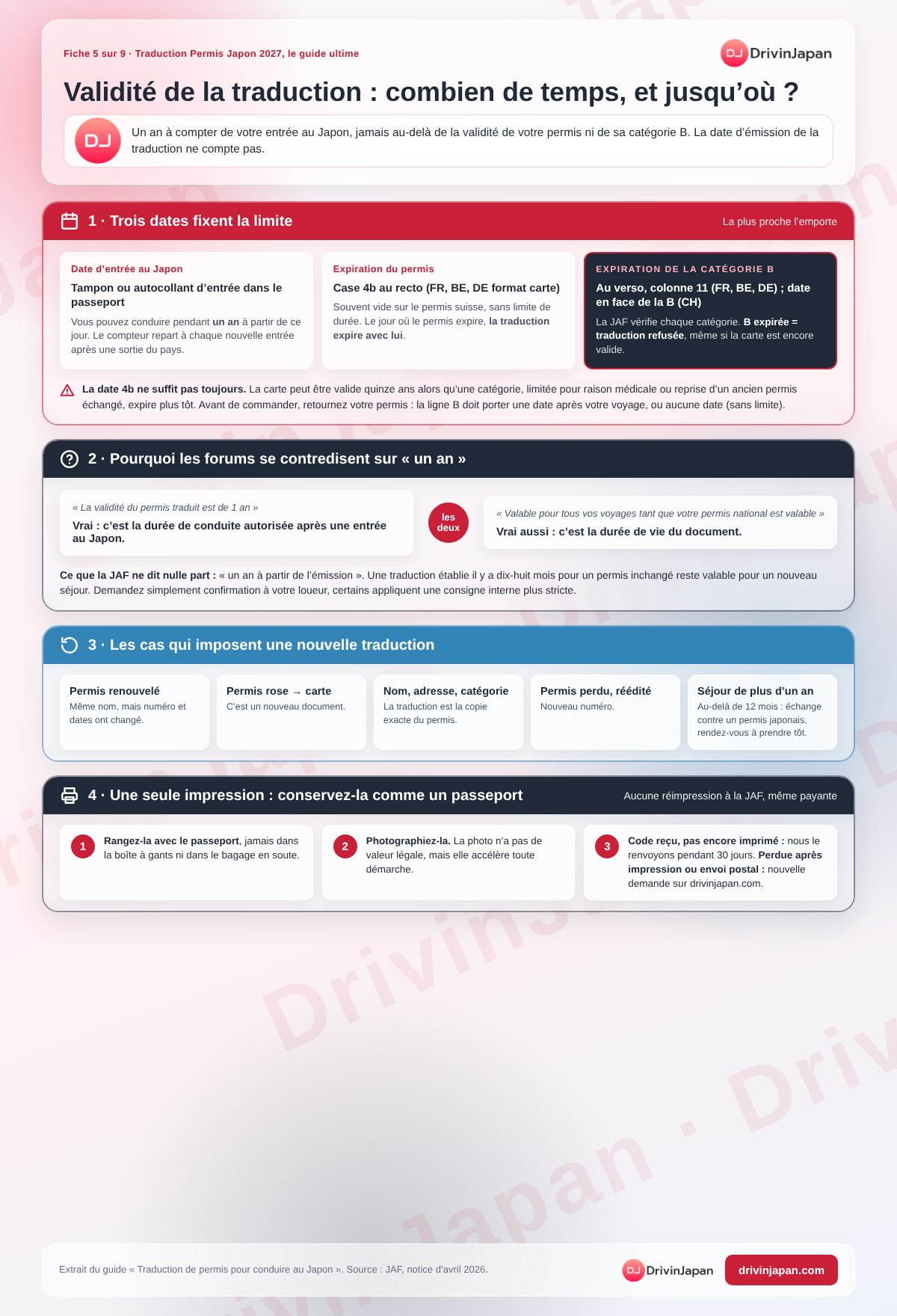
The short answer: the translation allows you to drive for one year from your date of entry into Japan, and never beyond the validity of your original licence or its category B. The translation’s issue date does not matter. A new licence, for whatever reason, requires a new translation. And the printed sheet is a one-off original.
Two dates set the limit
| Date | Where to find it | What it determines |
|---|---|---|
| Date of entry into Japan | Entry stamp or sticker in your passport | You can drive with the translation for one year from that day. The clock restarts with each new entry after leaving the country |
| Licence expiry date | Box 4b on the front of French, Belgian and German card-format licences. Often blank on the Swiss licence, which has no time limit | The day the licence expires, the translation expires with it |
| Category B expiry date | On the back, column 11 of the categories table on French, Belgian and German licences; the date column next to category B on the Swiss licence | The JAF checks every category. If B has expired, it refuses the translation even if the card is still valid |
So the 4b date isn’t always enough: the card may be valid for fifteen years while a category, limited for medical reasons or carried over from an old exchanged licence, expires sooner. Before ordering, turn your licence over and check that the B line shows a date after your trip, or no date at all, which means no limit.
Why the forums contradict each other on “one year”
“The translated licence is valid for 1 year,” writes one traveller. “The translated licence is valid for all your trips as long as your national licence is valid,” replies another. Both are right, and they aren’t talking about the same thing. The first is talking about how long you are allowed to drive after entering Japan; the second about the lifespan of the document. The confusion arises because many people read “one year” as “one year from the issue date”, which the JAF says nowhere. A translation issued eighteen months ago for an unchanged licence remains valid for a new stay; just ask your rental company to confirm, as some apply a stricter internal policy. All the special cases, with details of the dates on Belgian, Swiss and German licences, are in How long is the licence translation valid in Japan?
Cases that require a new translation
- Licence renewed, even with the same name: the number and dates have changed.
- Old pink paper licence exchanged for the card format: it is a new document.
- Change of name, printed address or category: the translation is an exact copy of the licence.
- Licence lost and then reissued: new number.
- Stay of more than one year: beyond twelve months, the translation no longer allows you to drive; you must exchange your licence for a Japanese one, and appointments are booked several weeks in advance.
Only one print: look after it like a passport
The printing code issued by the JAF allows only one print. The JAF offers no reprints, not even for a fee. A sheet lost after printing, or after being sent by post, means a whole new application. One traveller told of losing hers “on the first flight” and arriving in Tokyo without the document. Three precautions:
- Keep the translation with your passport, never in the glovebox or in your checked luggage.
- Take a photo of it. The photo has no legal value, but it speeds up any formalities.
- If you have received the code but not yet printed it, we can resend it to you for up to 30 days after the first sending. If the translation was lost after printing or after postal delivery, you will need to make a new application on drivinjapan.com, just as for a first order.
5. At the counter, then on the road
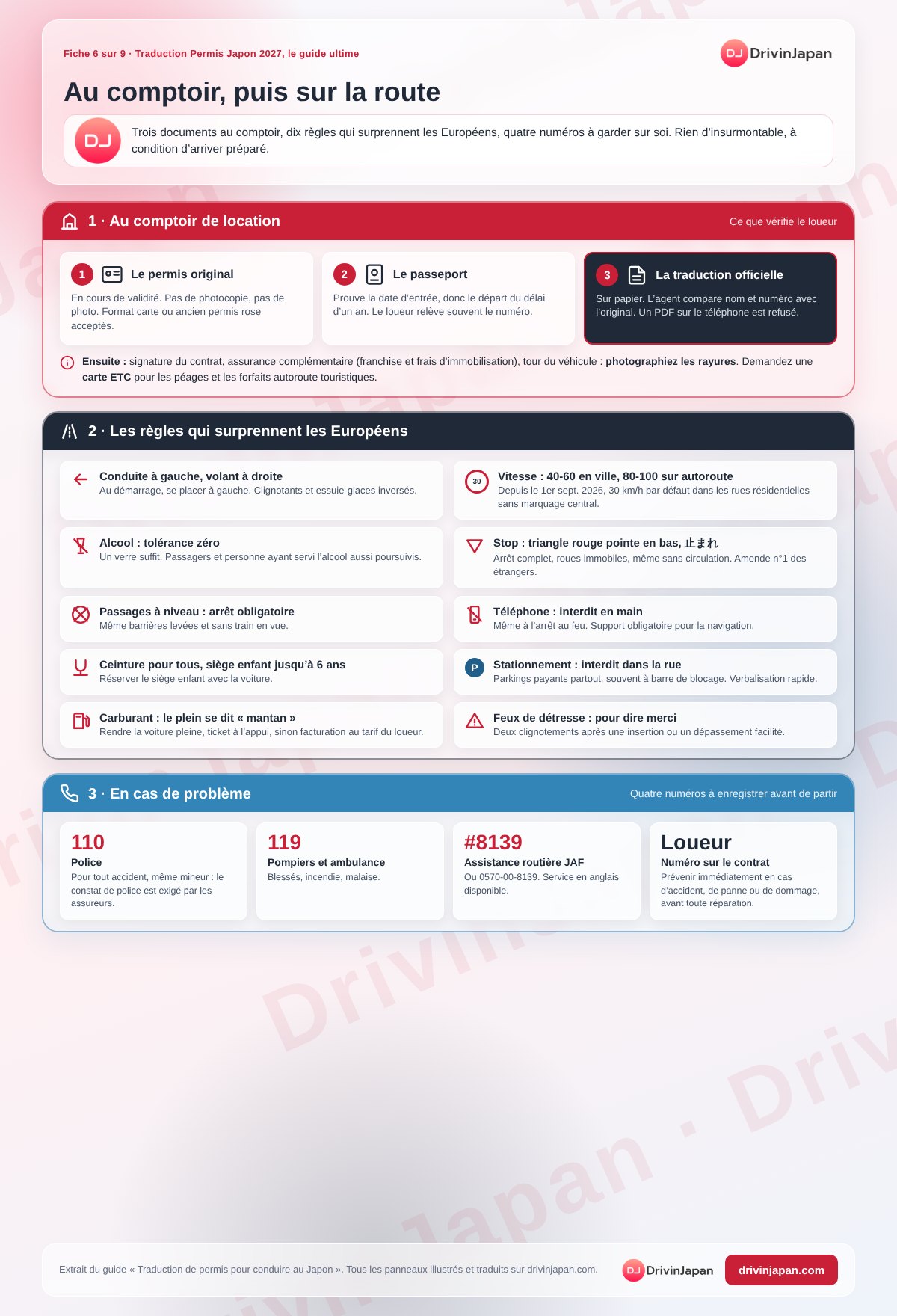
The short answer: at the counter, three documents, a contract, a vehicle inspection and an ETC card for tolls. On the road, you drive on the left, speed limits are low, alcohol at the wheel is banned with zero tolerance, and almost all signs are readable in the Latin alphabet. Nothing insurmountable, provided you arrive prepared.
The three documents, and what the rental company checks
- The original licence, currently valid. No photocopies, no photos. Both the card format and the old paper licence are accepted.
- Your passport, which proves your date of entry and therefore the start of the one-year period. The rental company often notes down the number.
- The official translation, on paper. The agent compares the name and licence number with the original. A PDF on your phone is refused.
The rental company will then ask you to sign the contract, offer you additional insurance covering the excess and the loss-of-use charges, and walk round the vehicle with you to note any existing scratches. Take photos. Ask for an ETC card if it isn’t included: it lets you go through tolls without stopping and take advantage of tourist expressway passes, which are often very good value for a road trip.
The rules that surprise Europeans
| Rule | In Japan | What you need to know |
|---|---|---|
| Side of the road | On the left, steering wheel on the right | The first reflex to correct: when you pull away, keep to the left. Indicators and wipers are swapped on most Japanese cars |
| Speed | Generally 40 to 60 km/h in town and on ordinary roads, 80 to 100 km/h on expressways, 120 on a few sections | Since 1 September 2026, 30 km/h by default on residential streets without a centre line, unless signed otherwise |
| Alcohol | Zero tolerance | One drink is enough to be committing an offence. Passengers and the person who served the alcohol can also be prosecuted |
| Stop | Red downward-pointing triangular sign, 止まれ, and road markings | A full stop is mandatory, wheels stationary, even with no traffic. This is the most common reason foreigners get fined |
| Level crossings | Mandatory stop before crossing | Even with the barriers up and no train in sight |
| Phone | Not allowed in your hand, even when stopped at traffic lights | A holder is mandatory for navigation |
| Seat belts and child seats | Seat belts for everyone, a suitable child seat up to age 6 | Book the child seat along with the car |
| Parking | Prohibited on the street unless explicitly marked | Paid car parks everywhere, often with a locking bar under the car. A badly parked car is ticketed quickly |
| Fuel | Full-service and self-service stations | The word for a full tank is “mantan”. Return the car with a full tank, with the receipt as proof, otherwise you’ll be charged at the rental company’s rate |
| Hazard lights | Used to say thank you | Two flashes after someone lets you merge or pass |
Reading the signs
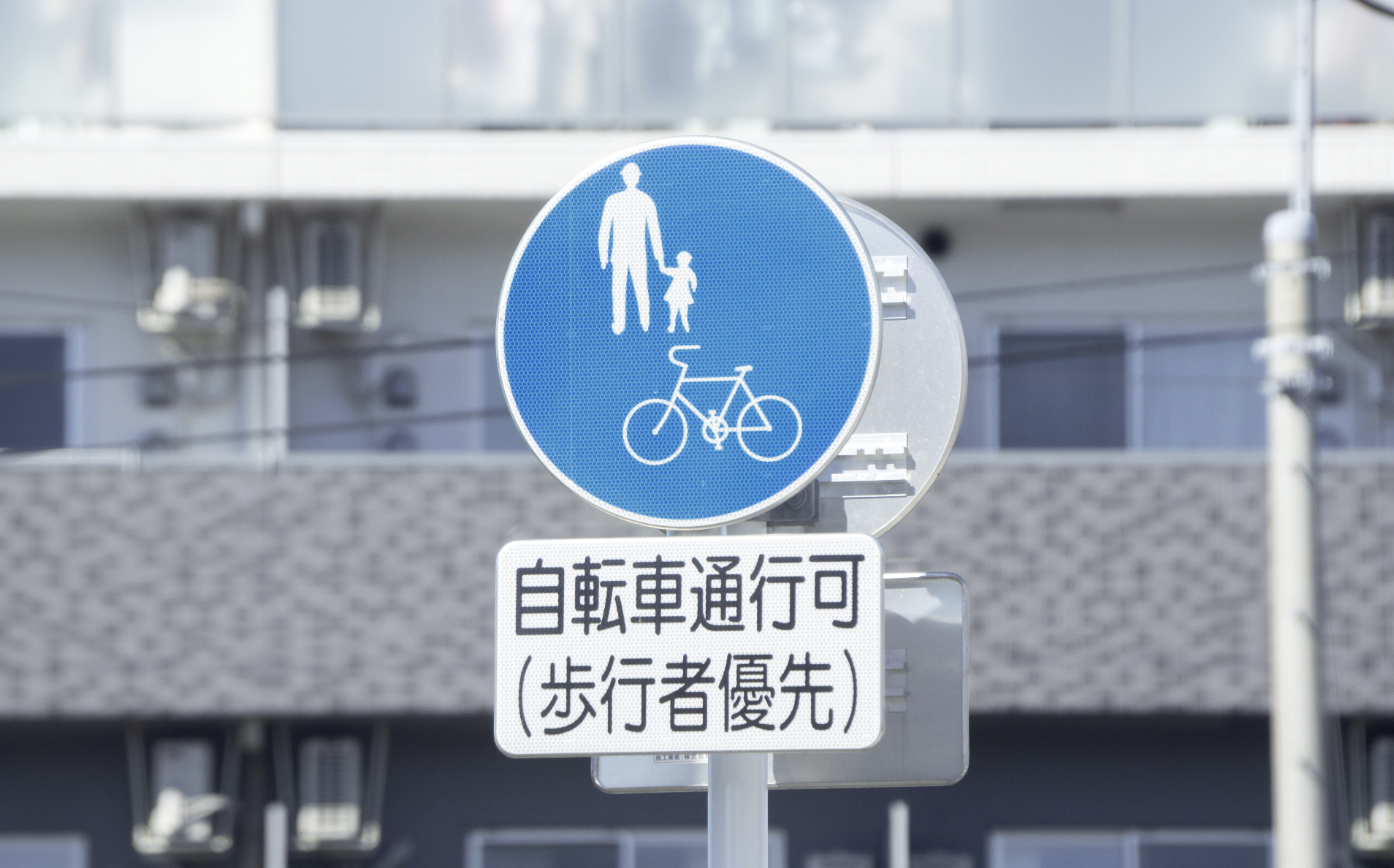
Direction signs are blue, with town names in Japanese and in the Latin alphabet. National route numbers appear in a shield, expressway numbers in a green panel. Speed limits are red circles with black numbers, as in Europe. A few signs have no European equivalent: the triangular stop sign, no parking and no stopping shown as crossed-out blue circles, school zone signs, and mandatory snow chain signs in winter. We have illustrated and translated them all on our page Guide signs in Japan, to read once before you leave and keep on your phone.
Expressways and tolls
Japanese expressways are excellent, safe and expensive: expect something like 10,000 yen to get from Tokyo to Osaka. Tourist passes such as the Japan Expressway Pass or the regional passes for Hokkaido and Kyushu greatly reduce the bill for a road trip of several days; they are booked with the car and loaded onto the ETC card. Service areas, called SA and PA, are clean, open 24 hours a day and are among the pleasures of the trip.
In winter
From late November to March, Hokkaido, Tohoku, the Sea of Japan coast and all mountain roads are snowy or icy. Winter tyres, known as studless tyres, are fitted as standard in Hokkaido and are optional elsewhere: ask for them when you book if your itinerary crosses these regions. Some high-altitude scenic roads close completely in winter. The Pacific coast, from Tokyo to Kyushu, generally stays clear.
If something goes wrong
- Police: 110. Call for any accident, even a minor one: Japanese insurers require a police report.
- Fire and ambulance: 119.
- JAF roadside assistance: #8139 from a mobile, or 0570-00-8139. Service available in English. The rental company also has its own assistance number, shown on the contract.
- Rental company: notify them immediately in the event of an accident, breakdown or damage, before any repairs.
If the rental company refuses your documents: plan B
You are at the counter and the agent explains that your papers aren’t acceptable. There are three ways out, in order of preference. If you are already in Japan, an official application is still possible from a local connection: you lose two to three working days, not the trip. In the meantime, start your itinerary by train, since the big cities can be visited without a car, and pick up the vehicle later, by moving the booking rather than cancelling it. And if the refusal comes down to a detail in your file, such as a name that doesn’t match or an illegible photo, write to us: we will check and tell you what to correct. In the vast majority of cases, this plan B is never needed, because the translation was prepared before departure.
Special cases: young drivers, motorbikes, long stays, seniors
The general rule covers the vast majority of travellers. A few situations deserve a little more explanation, because they come up regularly in the questions we receive and aren’t clearly answered elsewhere.
New licences and young drivers
The JAF translation does not require you to have held your licence for any minimum period: a licence obtained last week can be translated. Rental companies, however, apply their own conditions. Most rent from age 18, the legal driving age in Japan, but some require you to be 21 or to have held your licence for a year, and many charge a young driver surcharge or restrict vehicle categories. For example, the French probationary licence is accepted as it is; the speed limit specific to French probationary drivers does not apply in Japan, where only local limits count. Check the rental company’s age requirements before booking; they are set out in the terms and conditions in English.
Motorbikes and scooters
The translation reproduces all the categories on your licence, including A, A1 and A2 if you hold them. It therefore allows you to rent a motorbike in Japan under the same conditions as a car. Watch out for two things: category B does not allow you to ride a 125 cc in Japan, not even a French category B with the seven-hour training course, because this equivalence is specific to France; and motorbike rental companies often require minimum experience and a high security deposit. For a 50 cc scooter, category B is enough.
Campervans and large vehicles
Japanese rental campervans are almost all designed to stay under the category B limit of 3.5 tonnes, precisely so that tourists can drive them. Nevertheless, check the maximum authorised mass of the model you choose: some imported models exceed it and require a category that your European licence does not cover, translation or not. Minibuses with more than nine seats call for the same caution.
Stays of more than a year: students, working holiday visa holders, expats
The translation allows you to drive for the first twelve months after your entry into Japan. Beyond that, you must hold a Japanese licence, obtained by exchanging your European licence. For French, Belgian, Swiss and German licences, the exchange is done without a driving test, by appointment at a prefectural centre, with the JAF translation, the original licence, your passport, your residence card and proof that you lived for at least three months in the issuing country after obtaining your licence. Appointments are booked several weeks in advance in big cities: start the process in your ninth or tenth month, not the day before the deadline. The JAF translation used for the exchange is a separate document from the one for temporary driving, and the JAF charges 6,600 yen for it.
Drivers over 70
No Japanese rule sets an age limit for driving with a translation. Some rental companies, however, apply an upper age limit or ask for a medical certificate beyond 70 or 75, and some additional insurance policies exclude the oldest drivers. Here again, the answer lies in the rental company’s terms and conditions, which you should read before paying. Also bear in mind that category B on European licences may be time-limited for medical reasons from a certain age: it is the date on the back, column 11, that counts for the JAF.
Dual nationality and foreign licences
If you hold two licences, for example a French one and a Canadian one, choose the one that makes life easier: with the Canadian one, the Canadian International Driving Permit is enough; with the French one, you need the translation. Present only one consistent set of documents at the counter. If your European licence was obtained by exchanging a licence from another country, it remains a European licence in the eyes of the JAF and is translated in the normal way.
Choosing the right rental car
This isn’t the subject of this guide, but three choices made when booking avoid most unpleasant surprises at the counter, once the question of documents is settled.
- Automatic by default. Almost the entire Japanese fleet is automatic; manual gearboxes are rare and more expensive. It also makes getting used to driving on the left genuinely easier.
- Kei car or compact? Kei cars, recognisable by their yellow number plates, are economical, easy to park and sufficient for two people with little luggage. For four adults, suitcases or the mountains, a compact car or a people carrier is more comfortable. Tolls are cheaper in a kei car.
- Additional insurance. Basic insurance is included, with an excess. Rental companies offer an option that waives the excess and covers the loss-of-use charges billed after an incident, called NOC. For a family trip, it is generally worth the price.
- ETC and expressway passes. Ask when booking: the ETC card slots into the car’s reader and saves you stopping at tolls; tourist passes are loaded onto it.
- Navigation. Built-in sat navs often accept input by the place’s phone number or by Mapcode, which is more reliable than the address. Google Maps works well in Japan; remember to download offline maps for the mountains.
What happens during a police check
Roadside checks are frequent in Japan, especially around tourist areas and on country roads where speed limits are low. They are courteous and quick if your documents are in order. The officer asks for the original licence, the translation and sometimes your passport; they compare the names and numbers, note the number plate and let you go. With an International Driving Permit issued in France, Belgium, Switzerland, Germany or Monaco, there is no room for discussion: the document is not recognised, and you are driving without a valid licence, with a fine and the possibility that the car will be impounded until a properly licensed driver comes to collect it.
Two offences come up again and again among foreign visitors: failing to stop at a stop sign, because the Japanese sign doesn’t look like the European one and the stop must be complete; and speeding on roads that look wide and deserted but are limited to 40 or 50 km/h. Fixed speed cameras are signposted; mobile checks are not. Fines are generally paid within the following days at a post office or bank; the rental company may also recharge them to you with an administration fee if they reach it after you have left.
Country-by-country table: who needs what
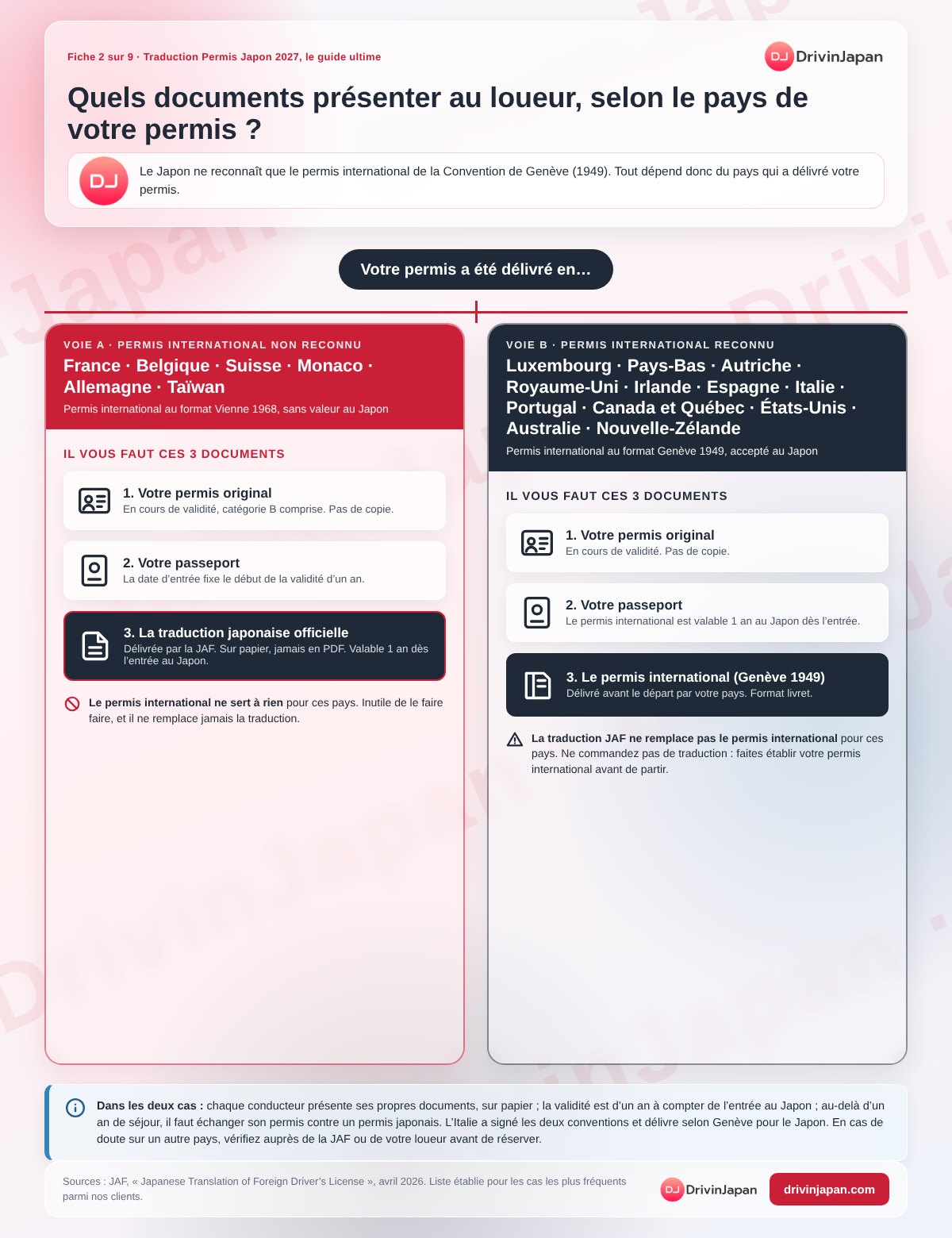
| Licence issued in | International Driving Permit | What you need in Japan |
|---|---|---|
| France, Belgium, Switzerland, Monaco | Vienna 1968 format: not recognised | Original licence + passport + official Japanese translation |
| Germany, Taiwan | Not recognised | Original licence + passport + official Japanese translation |
| Luxembourg, Netherlands, Austria, United Kingdom, Ireland, Spain, Italy, Portugal | Geneva 1949 format: recognised | Original licence + passport + International Driving Permit. For these countries, the JAF translation does not replace the International Driving Permit |
| Canada, United States, Australia, New Zealand | Geneva 1949 format: recognised | Original licence + passport + International Driving Permit |
| Quebec | Canadian International Driving Permit recognised | Same as Canada |
List drawn up for the most common cases among our customers. Italy has signed both conventions and issues under the Geneva Convention for Japan; if in doubt about another country, check with the JAF or your rental company before booking.
Countdown plan: what to do, and when
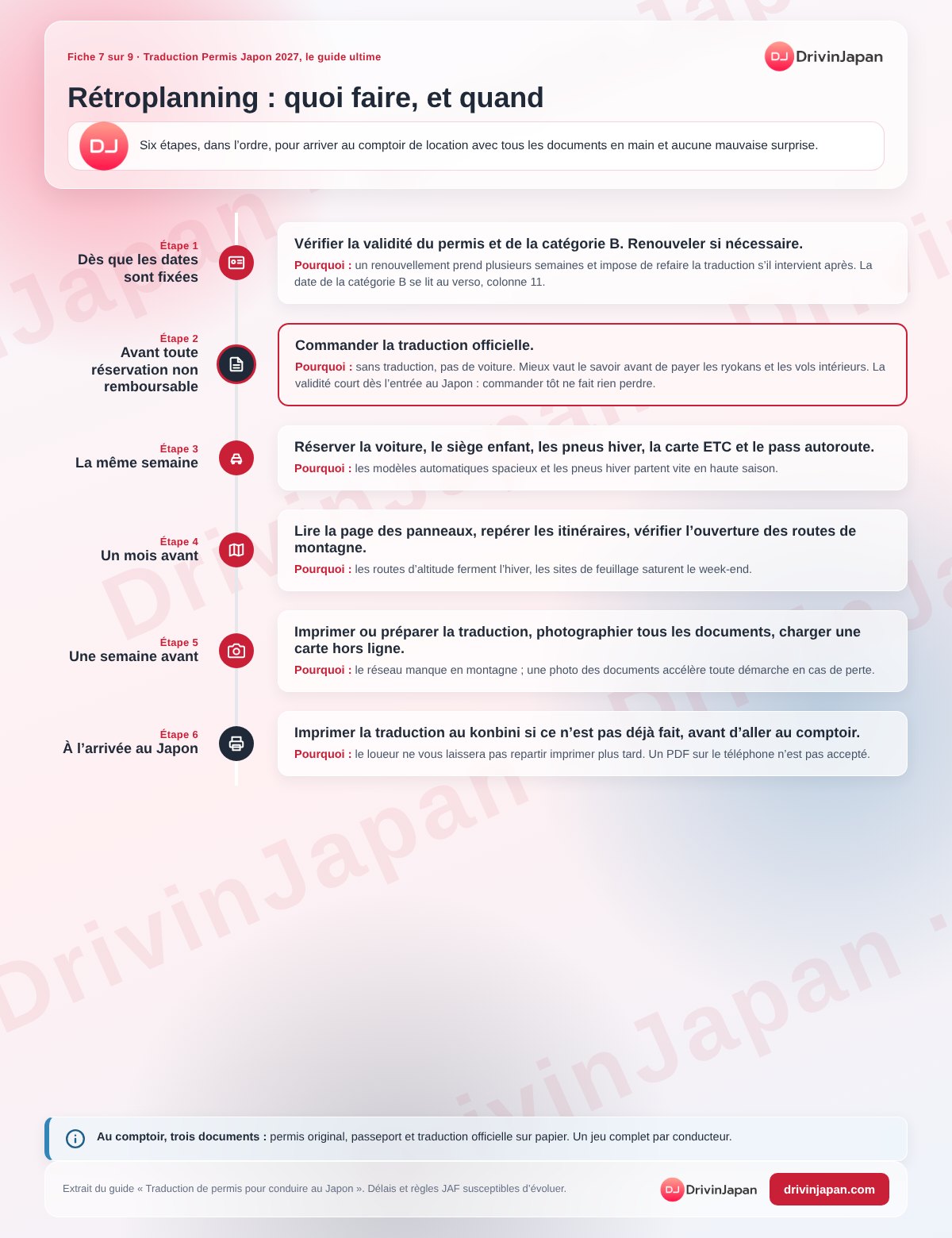
| When | What | Why |
|---|---|---|
| As soon as your dates are set | Check the validity of your licence and category B. Renew if necessary | A renewal takes several weeks and means redoing the translation if it happens afterwards |
| Before any non-refundable booking | Order the translation | No translation, no car; better to know before paying for ryokans and domestic flights |
| The same week | Book the car, child seat, winter tyres, ETC card and expressway pass | Spacious automatic models and winter tyres go quickly in high season |
| One month before | Read the road signs page, plan your routes, check that mountain roads are open | High-altitude roads close in winter; autumn foliage spots get packed at weekends |
| One week before | Print or prepare the translation, photograph all your documents, download an offline map | There is no signal in the mountains; a photo of your documents speeds up any formalities if they are lost |
| On arrival | Print the translation at a konbini if you haven’t already, before going to the counter | The rental company won’t let you leave to print it later |
Complete pre-departure checklist
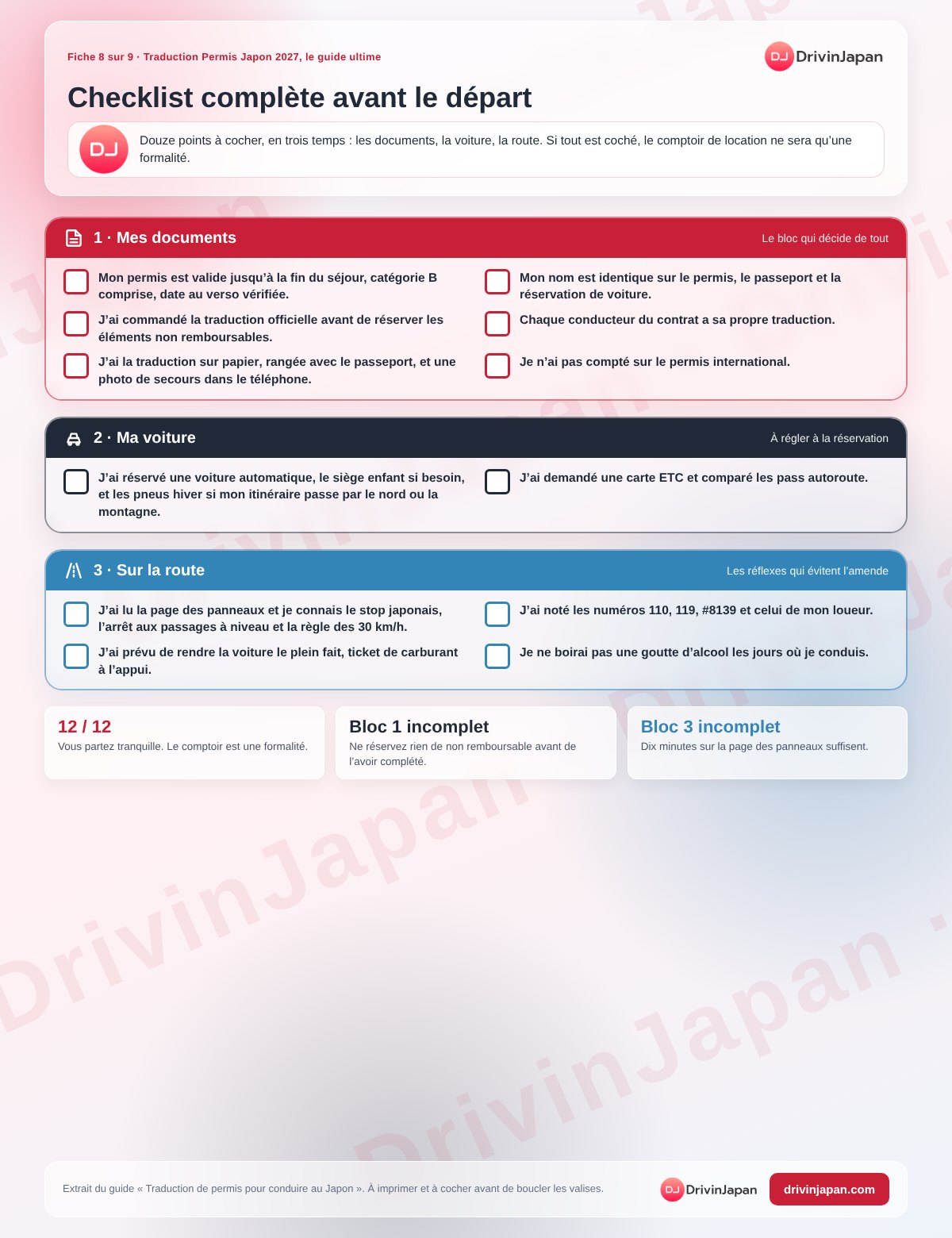
- My licence is valid until the end of my stay, including category B, with the date on the back checked.
- My name is identical on my licence, passport and car booking.
- I ordered the official translation before booking the non-refundable items.
- Every driver on the contract has their own translation.
- I have the translation on paper, kept with my passport, and a backup photo on my phone.
- I haven’t relied on the International Driving Permit.
- I have booked an automatic car, a child seat if needed, and winter tyres if my itinerary goes through the north or the mountains.
- I have asked for an ETC card and compared expressway passes.
- I have read the road signs page and I know the Japanese stop sign, the stop at level crossings and the 30 km/h rule.
- I have saved the numbers 110, 119, #8139 and my rental company’s number.
- I plan to return the car with a full tank, with the fuel receipt as proof.
- I know I won’t drink a drop of alcohol on the days I drive.
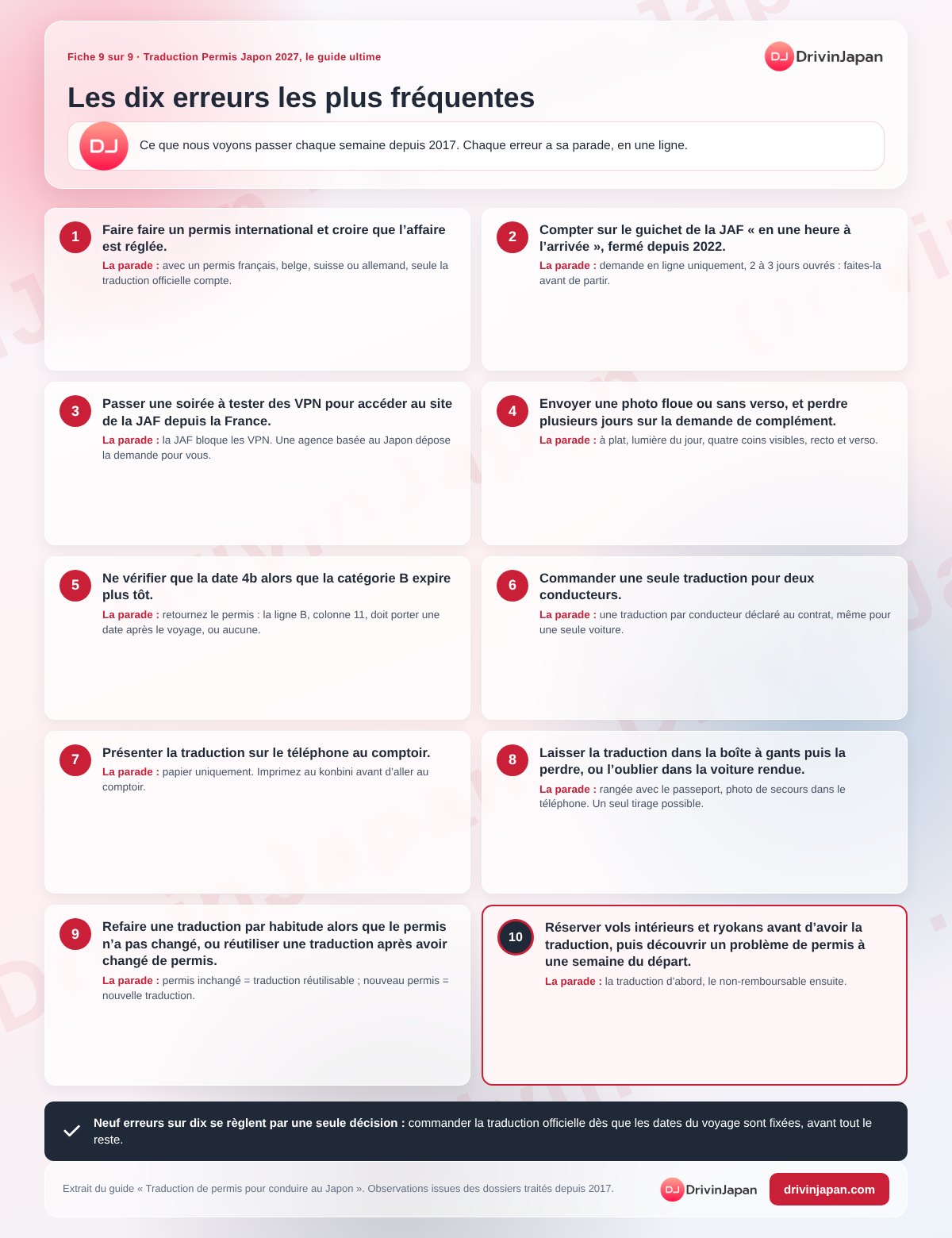
The ten most common mistakes
- Getting an International Driving Permit and thinking that’s that.
- Counting on the JAF counter “in one hour on arrival”, which has been closed since 2022.
- Spending an evening testing VPNs to access the JAF website from abroad.
- Sending a blurry photo or one without the back, and losing several days to the request for additional information.
- Only checking the 4b date when category B expires sooner.
- Ordering a single translation for two drivers.
- Showing the translation on your phone at the counter.
- Leaving the translation in the glovebox and then losing it, or forgetting it in the returned car.
- Getting a new translation out of habit when the licence hasn’t changed or, conversely, reusing a translation after changing licence.
- Booking domestic flights and ryokans before having the translation, then discovering a licence problem a week before departure.
To go further: discover the cafés, restaurants, accommodation and activities we have selected in our recommendations in Japan.
FAQ: licence translation and driving in Japan
Do you need a licence translation to rent a car in Japan with a licence from France, Belgium, Switzerland, Germany or Monaco?
Yes. With a French, Belgian, Swiss, German or Monegasque licence, the International Driving Permit is not recognised in Japan. The rental company requires the original licence, your passport and an official Japanese translation, issued by the JAF or a diplomatic mission.
How much does the JAF licence translation cost in 2026-2027?
6,000 yen per licence since 2026, plus 20 yen per page for printing at a konbini. The JAF offers no reprints: a sheet lost after printing means a whole new application. Through DrivinJapan, the official JAF translation costs €59.90 per licence, including photo checks and assistance in English.
Can you apply to the JAF from abroad?
No. Since late 2022, the JAF only accepts applications online, and only from an internet connection located in Japan. VPNs are blocked. From abroad, you have to go through a Japan-based agency such as DrivinJapan, which submits the official application for you.
How long does it take to get the translation?
At the JAF, 2 to 3 working days on average for a French, Belgian, Swiss or German licence, after an application made from Japan. Through DrivinJapan, the translation is issued within 24 to 48 hours on average after your photos are approved, before you leave.
How long is the translation valid?
One year from your date of entry into Japan, and never beyond the validity of your original licence or of its category B. The translation’s issue date does not matter: an older translation can still be used for a new stay if your licence has not changed.
Is the translation on my phone enough?
No. Only the paper version is accepted by rental companies and the police. A PDF or a photo of the translation has no value.
What happens if I drive without a translation?
You are driving without a valid licence. The rental company may refuse to give you the car; if you are stopped, you are committing an offence; in the event of an accident, the insurer may refuse to cover the damage. The translation is mandatory whether or not the rental company checks it.
There are two of us driving: do we need two translations?
Yes. Every driver named on the rental agreement must present their own licence and their own translation, even for a single car.
My licence is the old paper licence: is it accepted?
Yes, as long as it is legible and valid. The photos of the front and the inside pages must be sharp. If you exchange it for the card format before you leave, the translation must be based on the new document.
Do Luxembourg, Canadian or British licences need a translation?
No. These countries issue an International Driving Permit that complies with the 1949 Geneva Convention, which is recognised in Japan. Their drivers present their original licence and their International Driving Permit, with no translation.
Take the guide with you
The 12 pages as a PDF, to read offline on the plane or print out along with the checklist.
Download the guide (PDF) Free, no sign-up required.Ready to hit the road?
A photo of your licence is all it takes. You receive the official JAF translation before you leave, checked by our team, and you pick up your car without any fuss.
Order my licence translationSources and updates
This guide is reviewed and updated whenever the JAF changes a rule or fee, and at least every quarter. Last updated: November 2026. The information comes from official JAF documents, the “Japanese Translation of Foreign Driver’s License” notice of April 2026 and the “How to apply for a translation” page, from our direct exchanges with the JAF, from the terms and conditions of the main Japanese rental companies, and from the questions our customers have asked since 2017. Travellers’ quotes come from public French- and German-language forums. Rules, prices and lead times are subject to change: if in doubt about a specific point, write to us before booking.
Signed DrivinJapan, based in Osaka. 15,000 customers served since 2017 in obtaining their official JAF licence translation for Japan.